Student-Led IEPs: Helping Students Take Part in Their Own Meetings
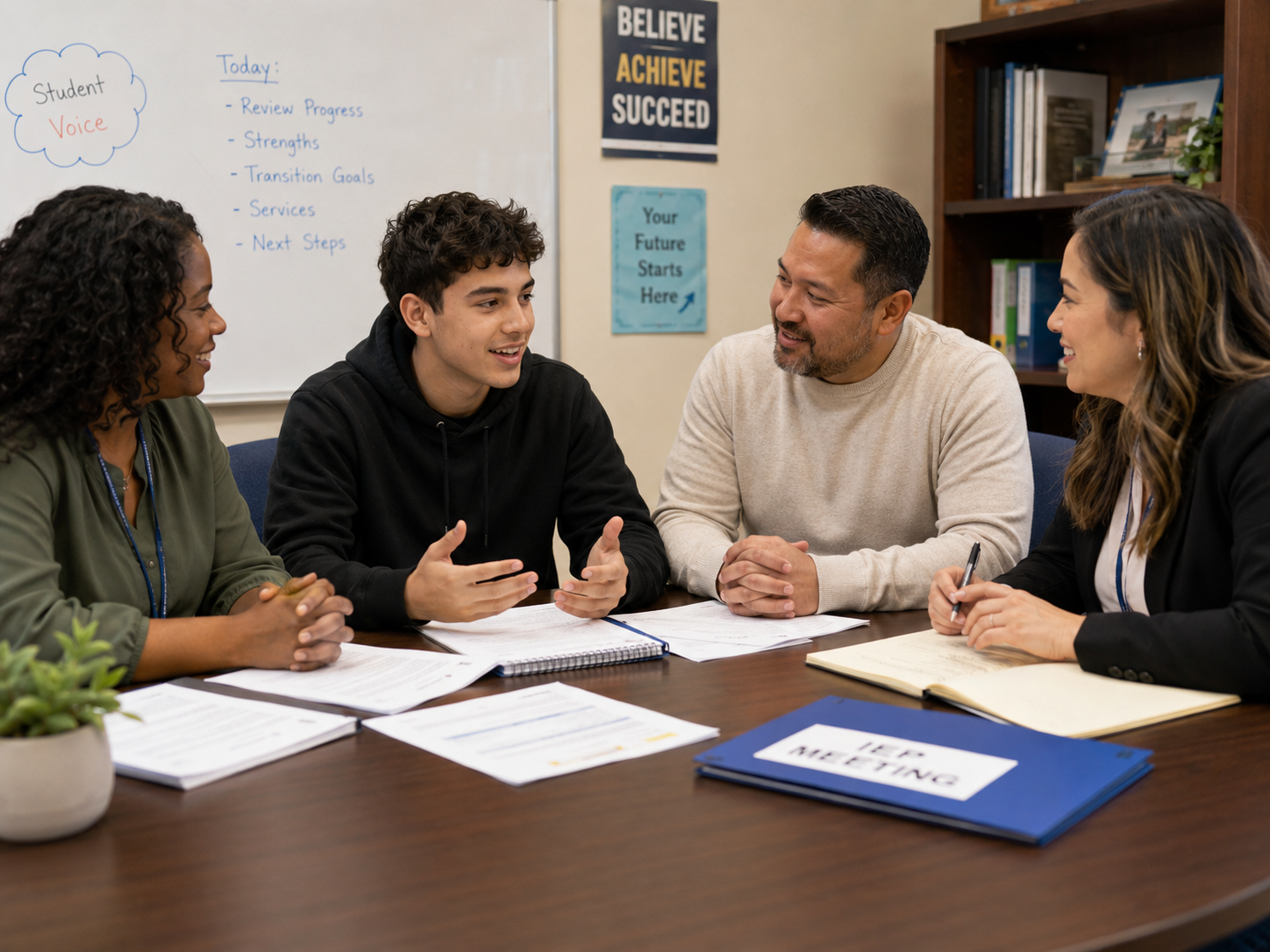
Picture the meeting that is all about your child's future, happening in a room without your child in it. For a long time, that was just how Individualized Education Program (IEP) meetings worked. Adults talked about the student, made plans for the student, and the student found out later, if at all.
It does not have to be that way. This post is a gentle, no-pressure guide to bringing your student's voice into their own IEP meeting. We will cover why it matters, what the law actually requires (and what it does not), a step-by-step participation "ladder" you can climb at your own pace, how to prepare a student, the roles adults play, and how to make participation work for every student through accommodations. If IEP meetings feel intimidating to you, you are not alone, and you do not have to do this all at once.
Why involving your student matters
The IEP is a plan for your student's life, so it makes sense for your student to have a seat at the table. When students take part, the IEP stops being something done to them and starts being something they help shape. The Center for Parent Information and Resources puts it simply: it is their life, so their voice belongs in the room.
The benefits are real. Students who take part in their IEP meetings tend to build confidence, communication skills, and self-advocacy, and they often grow in areas like social skills and personal management (CHADD). When a young person can describe what helps them learn and what they want for their future, those skills carry far beyond the meeting.
Research supports this, too, though it is important to be honest about what it shows. In a randomized study of 130 secondary students, a curriculum that taught students to take part in their meetings sharply increased how much students contributed to the transition discussion, and students more often started and helped lead their meetings (Martin and colleagues, 2006). A separate follow-up of 779 students found that stronger self-determination at the end of high school was linked to better employment and community outcomes a year later (Shogren, Wehmeyer, and colleagues, 2015). These are encouraging links, not guarantees. Every student is different. But the direction is clear: when students learn to advocate for themselves, good things tend to follow.
A quick note on two words: self-advocacy and self-determination
You will hear both of these words a lot, so here is the plain-language difference.
Self-advocacy is a skill: understanding your own needs and asking for what helps. It is asking for a quieter testing room, or telling a teacher that written directions help you more than spoken ones. (See our glossary entry on self-advocacy.)
Self-determination is the bigger picture: the capacity to make choices and steer your own life. It includes setting goals, weighing options, and acting on your own preferences.
Self-advocacy is one piece of self-determination. Taking part in your own IEP meeting builds both at once, in a real and hands-on way.
What the law actually says (and does not)
This is the most important section to get right, because it is easy to overstate.
Under the federal special education law, the Individuals with Disabilities Education Act (IDEA), the school must invite the student to the IEP meeting when a purpose of that meeting is to consider the student's after-high-school goals and the transition services needed to reach them. If the student does not attend, the school still has to take other steps to make sure the student's preferences and interests are considered.
Here is the key point: the law requires that the student be invited. It does not require the student to attend, and it certainly does not require the student to lead. Until the age of majority (18 in most states), parents, often together with the student, decide whether the student attends (Center for Parent Information and Resources). So you are in the driver's seat about how much your student takes part, and you can change that decision over time.
When does transition planning begin? Federally, transition goals and services must be in the IEP no later than the first IEP in effect when the student turns 16, or younger if the team decides it is appropriate (34 CFR 300.320(b)). Many states start earlier, and that includes New York and New Jersey. (For a plain definition of the plan itself, see our glossary entry on the IEP.)
New York and New Jersey at a glance
| State | Transition planning begins | What this means |
|---|---|---|
| New York | Age 14 (career assessment at 12) | A Level 1 career assessment is completed at age 12 and informs later planning. By the age-14 IEP meeting, the team discusses transition, and the student must be invited whenever transition services may be discussed (NYC Public Schools). |
| New Jersey | Age 14 (or younger if appropriate) | At 14, the IEP must state the student's strengths, interests, and preferences and address the course of study. By the IEP in effect when the student turns 16, the plan must add measurable postsecondary goals and transition services, and the district must invite the student; if the student does not attend, the district takes other steps to consider their preferences and interests (N.J.A.C. 6A:14-3.7). |
If you are a New York or New Jersey family, this is good news: your student is meant to be part of the process earlier than many national articles suggest. In New York, a Level 1 career assessment is completed at age 12, and the student must be invited once transition is discussed, beginning at age 14.
The participation ladder: start where your student is
It helps to think of student involvement as a ladder, not a switch. You do not flip it on overnight. You climb one rung at a time, and any rung is a real win. The free Student Rubric for IEP Participation describes participation in graduated levels like these, so a student can see where they are now and pick one small next step.
Rung 1 — Attend and listen. The student comes to the meeting, maybe just for part of it, and observes. They see who is there and that the room is on their side.
Rung 2 — Share strengths, preferences, interests, and needs. The student introduces themselves and shares a little about who they are and what they want. A simple "SPIN" framework (Strengths, Preferences, Interests, Needs) makes this easy. The free I'm Determined One-Pager is a single fillable page built for exactly this.
Rung 3 — Present part of the meeting. The student leads one section, such as "here is what is working for me this year, and here is what is not."
Rung 4 — Help lead the meeting. The student helps run the agenda, introduces the team, and guides the discussion of their goals.
You might spend a year or two on each rung. A student who attends and listens this year, and shares a One-Pager next year, is making excellent progress. There is no rush.
How to prepare your student
Preparation is what turns a nerve-wracking meeting into a comfortable one. The more your student knows ahead of time, the easier it feels (Understood).
- Review the IEP together beforehand. Walk through it in plain language. Explain what an IEP is, who will be there, and what usually happens.
- Decide together what to share. Your student chooses what they are comfortable saying. Nothing is required.
- Practice. Role-play the parts they will say. A quick rehearsal at the kitchen table builds real confidence.
- Use sentence-starters. Short scripts take the pressure off. For example: "One thing that helps me is...," "A goal I have is...," and "I'd like to try...."
- Bring a tool. The One-Pager gives the student something concrete to hold and read from.
- Pick the next rung. The free Student Rubric for IEP Participation helps a student see where they are now and choose one small next step. You do not need to buy a curriculum. These free tools are enough to get started.
Roles for the adults: coach, do not speak for them
This is where well-meaning adults sometimes slip. When a student pauses or seems unsure, it is tempting to jump in and answer for them. CHADD's advice is to encourage and ask for the student's thoughts, and to gently redirect if others start grilling them (CHADD). In our coaching experience, one small habit makes a big difference: after you ask, leave a little silence and give the student time to fill it. For parents and teachers, the role is to prompt, encourage, and protect space:
- Prep beforehand so the student is not surprised.
- Ask the student for their thoughts, then give them time to answer.
- Gently redirect if other adults start talking over the student.
- Afterward, debrief in age-appropriate terms: tell the student what happened and what changed. Professional resources describe this as putting the student "in the driver's seat" (IRIS Center, Vanderbilt). The adults keep the car steady; the student decides where it is going.
Making it accessible to every student
Participation should not depend on being talkative or confident on the spot. Accommodations are how the right to take part becomes real, especially for students who are nonspeaking, anxious, or have significant support needs (Edutopia). Options include:
- A pre-recorded video the student plays instead of speaking live.
- An AAC (augmentative and alternative communication) device.
- A portfolio or slideshow that shows their work and goals.
- Choosing the seating or location so the student feels at ease.
- Helping create the agenda ahead of time.
- An agreed signal or pause the student can use if they feel overwhelmed.
- A simplified IEP summary the student keeps for reference. Accommodations are a way to take part, not a reason to opt out. To learn more about requesting them, see our guide to reasonable accommodations at school and work.
Start small, start early, and stay age-appropriate
You do not have to wait for the transition age to begin. Even elementary-age students can take part in small ways, like sharing a favorite subject or something that helps them learn (CHADD). Involvement is a skill built over years, not a switch flipped at 14 or 16. One new rung per year is plenty. The goal is steady, comfortable growth, not a perfect performance.
Common Questions
Does my child have to attend or lead the meeting?
No. The law requires that your student be invited when transition is on the agenda. It does not require them to attend or to lead. Until the age of majority, you and your student decide together how involved to be.
What if my child gets anxious or is nonspeaking?
There are many ways to take part. A student can share a One-Pager read aloud by someone else, play a short pre-recorded video, use an AAC device, present a portfolio, or attend only part of the meeting. Accommodations make participation realistic for every student.
When should we start?
Earlier than the legal age is completely fine, and often helpful. In both New York and New Jersey, the student's strengths, interests, and preferences become part of transition planning starting at age 14, but younger students can join in small, age-appropriate ways long before then.
Can my student really run their own meeting someday?
Yes. With preparation and practice, many students do help lead their meetings. It usually happens gradually, one rung at a time, and that is exactly how it should.
Learn More
- IDEA, 34 CFR 300.321(b): inviting the student to the IEP meeting (U.S. Department of Education)
- IDEA, 34 CFR 300.320(b): transition services in the IEP
- New York: NYSED Indicator 13, Secondary Transition
- New Jersey: N.J.A.C. 6A:14-3.7, Individualized Education Program
- I'm Determined One-Pager and Student Rubric for IEP Participation (free tools)
- Students Get Involved! and Student with a Disability on the IEP Team (Center for Parent Information and Resources)
- When Students Attend IEP Meetings (CHADD) and Should I encourage my child to go to IEP meetings? (Understood)
- What is an IEP and how does it support my child? (PACER Center)
- Our glossary: IEP and self-advocacy
- Related reading: Executive Function Skills: A Practical Guide for Families and Students, Reasonable Accommodations: A Guide to Your Rights at School and Work, and Leveraging Strengths: Teaching Job Readiness Skills
Helping a student find their voice in their own IEP meeting is one of the most empowering steps in the journey to adulthood, and you do not have to figure it out alone. Lincoln Square Coaching helps students across New York and New Jersey build the self-advocacy and self-determination skills behind student-led IEPs through our transition and Pre-ETS services. If you would like a partner in this, reach out to our team. We would love to help.